Abstract
The growing proportion of elderly patients undergoing surgical procedures presents distinct anesthetic and perioperative management challenges related to age-related physiological decline, polypharmacy, and increased comorbidity burden. This study examines anesthetic technique selection, perioperative risk-stratification tools, and postoperative complication rates among geriatric surgical patients across a range of elective and emergency procedures. Particular attention is given to postoperative cognitive dysfunction, cardiovascular stability, and recovery trajectory as key outcome measures. The findings support the development of standardized geriatric perioperative care pathways aimed at reducing complication rates and improving functional recovery in this high-risk surgical population.
- Geriatric Surgery
- Perioperative Risk
- Anesthesia
- Postoperative Cognitive Dysfunction
- Elderly Patients
- Surgical Outcomes
- Risk Stratification
Introduction#
E-governance has emerged as an important tool for improving governance and public service delivery in developing economies. It refers to the use of information and communication technologies by government institutions to provide services, share information, manage administrative processes and interact with citizens. In the traditional system, citizens often faced delays, paperwork, long queues, lack of information and dependency on intermediaries. E-governance attempts to reduce these problems by making government services faster, simpler, more transparent and citizen-centred.
In developing economies, public service delivery is often affected by challenges such as bureaucratic delays, limited administrative capacity, corruption, poor infrastructure, lack of accountability and unequal access to services. E-governance initiatives help address these challenges by introducing online portals, mobile applications, digital identity systems, electronic payments, online certificates, digital grievance redressal systems and service tracking mechanisms. These tools reduce physical visits to government offices and make services available at any time and from different locations.
Public service delivery is one of the major areas influenced by e-governance. Services related to birth and death certificates, land records, tax payments, welfare schemes, pensions, licenses, health services, education records and public grievances can be delivered through digital platforms. This improves speed, accuracy and convenience. When citizens receive services without unnecessary delay and harassment, their trust in government increases. Thus, e-governance plays an important role in making administration more responsive and efficient.
Citizen satisfaction is another important dimension of e-governance. Citizens are more satisfied when government services are easy to access, affordable, timely, transparent and reliable. User-friendly websites, mobile applications, helplines and online grievance systems improve citizen experience. However, citizen satisfaction also depends on digital literacy, internet connectivity, language support, data privacy and service quality. If digital platforms are complex or inaccessible, e-governance may fail to benefit all citizens equally.
Administrative transparency is a key objective of e-governance. Digital systems can reduce corruption and improve accountability by making information available to citizens. Online tracking of applications, digital records, public dashboards, e-tendering and direct benefit transfers reduce human interference and discretionary power. This helps prevent misuse of authority and improves public monitoring. Transparency also strengthens democratic governance because citizens can access information and hold institutions accountable.
In developing economies, e-governance has special importance because it supports inclusive development and administrative modernization. It can help reach rural areas, marginalized communities and economically weaker sections if proper infrastructure and awareness are provided. Digital governance can reduce the gap between citizens and government by improving access to welfare schemes and public services. However, challenges such as the digital divide, low digital literacy, poor connectivity, cyber security risks and lack of institutional readiness must be addressed.
The present study titled “Impact of E-Governance Initiatives on Public Service Delivery, Citizen Satisfaction, and Administrative Transparency in Developing Economies” is significant because it examines how digital governance reforms influence the quality of administration and citizen experience. It focuses on the relationship between e-governance, service efficiency, satisfaction and transparency. The study also highlights the need for inclusive digital policies, capacity building, secure platforms and citizen awareness.
Thus, e-governance is not merely a technological reform; it is a governance transformation. When implemented effectively, it can improve public service delivery, enhance citizen satisfaction, reduce corruption and strengthen administrative transparency. Therefore, e-governance initiatives are essential for building efficient, accountable and citizen-friendly governance systems in developing economies.
Evolution and Conceptual Framework of E-Governance in Developing Economies#
The rapid advancement of information and communication technologies (ICTs) has significantly transformed the functioning of governments across the world. In contemporary society, governments are increasingly adopting digital technologies to improve administrative efficiency, service delivery, transparency, and citizen participation. This transformation has given rise to the concept of e-governance, which has become an essential component of public administration in both developed and developing economies. E-governance represents a paradigm shift from traditional bureaucratic administration to technology-enabled, citizen-centric, and transparent governance systems.
The concept of e-governance emerged during the late twentieth century with the expansion of computerization, internet technologies, and digital communication systems. Initially, governments primarily used information technologies for internal administrative functions such as record management, payroll processing, and data storage. However, the widespread availability of the internet and digital communication networks expanded the scope of technology applications in governance. Governments gradually began using digital platforms for delivering public services, disseminating information, interacting with citizens, and facilitating administrative processes. Consequently, e-governance evolved from simple computerization to comprehensive digital governance involving multiple stakeholders and service domains.
E-governance can be broadly defined as the application of information and communication technologies by government institutions to provide public services, exchange information, improve administrative efficiency, and promote transparency and citizen participation. The World Bank defines e-governance as the use of information technologies by government agencies that have the ability to transform relations with citizens, businesses, and other arms of government. Similarly, the United Nations describes e-governance as the utilization of ICTs and digital tools to improve public administration, enhance service delivery, and strengthen democratic governance.
The conceptual framework of e-governance extends beyond the mere digitization of government activities. It encompasses the transformation of governance structures, administrative processes, and relationships among various stakeholders. E-governance aims to create a governance system characterized by efficiency, effectiveness, transparency, accountability, responsiveness, and inclusiveness. It seeks to reduce bureaucratic delays, simplify administrative procedures, minimize corruption, and improve accessibility to public services. Thus, e-governance is not simply a technological innovation; it represents a broader administrative reform process.
The evolution of e-governance can be understood through several stages. The first stage involved computerization, wherein government offices introduced computers for basic administrative tasks such as maintaining records, processing documents, and managing internal operations. Although computerization improved operational efficiency, interactions between government and citizens largely remained traditional and paper-based.
The second stage involved the development of networking and online presence. During this phase, government departments established websites and digital communication systems to disseminate information and facilitate communication. Citizens could access information regarding government programmes, policies, regulations, and procedures through online platforms. This stage enhanced information accessibility and reduced dependence on physical visits to government offices.
The third stage involved transactional e-governance, characterized by the provision of online public services. Citizens gained the ability to submit applications, pay taxes, obtain certificates, access welfare benefits, and lodge grievances through digital platforms. Online service delivery significantly reduced administrative delays, transaction costs, and procedural complexities.
The current stage of e-governance emphasizes integrated and transformational governance. Governments increasingly utilize advanced technologies such as cloud computing, artificial intelligence, big data analytics, mobile applications, blockchain, and digital identity systems to provide seamless and integrated services. The objective is to create citizen-centric governance systems where multiple services are accessible through unified digital platforms. Such integration enhances efficiency, coordination, and user convenience.
The conceptual framework of e-governance includes several important dimensions. One major dimension is Government-to-Citizen (G2C) interaction. G2C initiatives facilitate direct communication and service delivery between governments and citizens. Examples include online tax filing, digital certificates, electronic voting information, grievance redressal systems, and welfare service portals. G2C services enhance accessibility, convenience, and citizen satisfaction by reducing physical barriers and procedural complexities.
Another important dimension is Government-to-Business (G2B) interaction. G2B initiatives support interactions between government institutions and business organizations. Electronic procurement systems, online licensing, digital taxation, e-tendering, and regulatory compliance platforms are examples of G2B services. Such initiatives reduce administrative burdens, improve business environments, and promote economic development.
Government-to-Government (G2G) interaction constitutes another essential component of e-governance. G2G systems facilitate communication, coordination, and information sharing among different government departments and agencies. Integrated databases, interdepartmental networks, and shared information systems improve administrative coordination and decision-making. Effective G2G interaction reduces duplication, enhances efficiency, and strengthens institutional collaboration.
The fourth dimension is Government-to-Employee (G2E) interaction. G2E initiatives focus on improving administrative management and employee services within government organizations. Digital payroll systems, online leave management, performance appraisal systems, and employee information portals enhance internal administrative efficiency and employee satisfaction.
Developing economies have increasingly adopted e-governance as a strategy for improving governance and accelerating socio-economic development. Many developing countries face challenges such as bureaucratic inefficiency, corruption, limited administrative capacity, inadequate infrastructure, and unequal access to public services. E-governance offers opportunities to address these challenges by enhancing administrative transparency, improving service delivery, and strengthening accountability mechanisms.
In the context of developing economies, e-governance initiatives often focus on improving access to essential public services such as healthcare, education, social welfare, land records, taxation, and identity management. Digital identity programmes, direct benefit transfer systems, mobile governance initiatives, and online grievance redressal mechanisms have significantly improved public service accessibility in many countries. In India, initiatives such as Digital India, Aadhaar, Unified Payments Interface (UPI), DigiLocker, e-District, and Direct Benefit Transfer (DBT) programmes illustrate the growing importance of e-governance in public administration.
The implementation of e-governance is guided by several core principles. Transparency refers to the openness and accessibility of government information and processes. Digital platforms enable citizens to access information regarding government policies, expenditures, service procedures, and administrative decisions, thereby reducing opportunities for corruption.
Accountability represents another fundamental principle. E-governance systems create digital records and transaction trails that facilitate monitoring, auditing, and performance evaluation. Such mechanisms strengthen institutional accountability and improve public trust.
Citizen participation constitutes an essential aspect of democratic governance. E-governance platforms facilitate citizen engagement through online consultations, feedback mechanisms, grievance systems, and participatory decision-making processes. Enhanced participation contributes to responsive and inclusive governance.
Efficiency and effectiveness are equally important objectives. E-governance reduces administrative costs, minimizes procedural delays, improves resource utilization, and enhances service quality. Efficient governance systems contribute to improved citizen satisfaction and organizational performance.
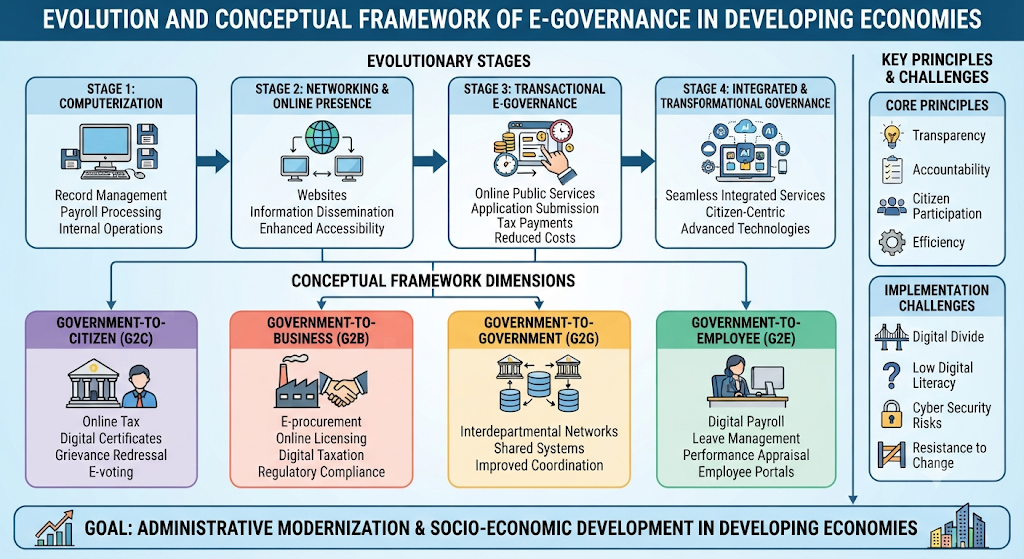
Figure: Evolution & Conceptual Framework of E-Governance in Developing countries
Despite its numerous benefits, e-governance implementation in developing economies faces several challenges. The digital divide, characterized by disparities in access to digital technologies and internet connectivity, remains a major concern. Rural populations, economically disadvantaged groups, elderly citizens, and marginalized communities often experience limited access to digital services. Low digital literacy, inadequate infrastructure, cyber security risks, resistance to organizational change, and limited institutional capacities further complicate implementation efforts.
The success of e-governance therefore depends upon multiple factors, including technological infrastructure, digital literacy, institutional readiness, political commitment, legal frameworks, and citizen awareness. Capacity-building initiatives, infrastructure development, and inclusive policies are essential for ensuring equitable access to digital governance services.
A multidisciplinary perspective is important for understanding e-governance because it intersects with public administration, information technology, political science, economics, sociology, and development studies. Public administration examines governance reforms and organizational processes; information technology focuses on technological systems; political science analyzes democratic participation and accountability; and sociology explores social inclusion and digital inequalities. Such interdisciplinary understanding contributes to effective e-governance policies and implementation strategies.
In conclusion, the evolution of e-governance reflects the ongoing transformation of public administration in response to technological advancement and changing citizen expectations. The conceptual framework of e-governance emphasizes efficiency, transparency, accountability, participation, and citizen-centric service delivery. In developing economies, e-governance serves as an important instrument for administrative modernization, public service improvement, and socio-economic development. Therefore, strengthening e-governance systems remains essential for building effective, inclusive, and transparent governance institutions in the digital era.
E-Governance and Transformation of Public Service Delivery Systems#
E-governance has significantly transformed public service delivery systems by replacing traditional paper-based, office-centred and time-consuming administrative procedures with digital, transparent and citizen-friendly services. Public service delivery refers to the process through which government provides essential services such as certificates, licenses, pensions, welfare benefits, land records, tax services, health facilities, education services and grievance redressal to citizens. In developing economies, these services were often affected by delays, corruption, long queues, lack of information and dependency on middlemen. E-governance helps reduce these problems by using digital platforms for faster and more efficient service delivery.
One of the major contributions of e-governance is the improvement of service accessibility. Citizens can access government services through online portals, mobile applications, common service centres and digital kiosks without repeatedly visiting government offices. This is especially useful for rural people, elderly citizens, women, workers and persons who live far from administrative centres. Services such as online application submission, status tracking, digital payment and document download make public service delivery more convenient and time-saving.
E-governance also improves the speed and efficiency of services. Digital systems reduce manual paperwork, file movement and physical verification delays. Applications can be processed faster through online records, automated workflows and integrated databases. For example, services related to birth certificates, income certificates, caste certificates, tax payments and welfare schemes can be delivered more quickly through digital platforms. This improves administrative efficiency and reduces public dissatisfaction.
Transparency is another important transformation brought by e-governance. In traditional systems, citizens often had limited information about procedures, fees, eligibility and application status. Digital governance platforms provide clear information and allow citizens to track their applications. This reduces uncertainty, corruption and unnecessary dependence on officials. Online records, digital receipts and service timelines increase accountability in public administration.
E-governance also supports direct benefit delivery. In many developing economies, welfare schemes are affected by leakage, duplication and delay. Digital identity systems, bank-linked transfers and online beneficiary databases help ensure that benefits reach the intended citizens directly. Direct Benefit Transfer systems reduce intermediaries and improve the accuracy of welfare service delivery. This strengthens trust between citizens and government.
Grievance redressal has also improved through e-governance. Online complaint portals, helplines, mobile apps and tracking systems allow citizens to register complaints and monitor action taken by departments. Such systems make administration more responsive and accountable. When citizens receive timely solutions to their problems, their satisfaction with governance increases.
E-governance has also transformed public service delivery by promoting interdepartmental coordination. Many services require information from different government departments. Integrated digital platforms allow departments to share data and reduce duplication of work. This improves coordination, reduces administrative burden and provides smoother services to citizens.
However, the transformation of public service delivery through e-governance depends on several conditions. Digital infrastructure, internet connectivity, digital literacy, trained staff, cyber security and citizen awareness are necessary for successful implementation. If citizens do not know how to use online services, or if platforms are difficult to operate, the benefits of e-governance may remain limited. Similarly, poor connectivity and lack of local-language support may exclude rural and marginalized populations.
Citizen Satisfaction and Public Participation in Digital Governance#
Citizen satisfaction and public participation are among the most important indicators of effective governance in the digital era. The primary objective of e-governance is not merely the adoption of technology but the creation of citizen-centric governance systems that are responsive, accessible, transparent, and efficient. In contemporary public administration, citizens are no longer viewed simply as passive recipients of government services; rather, they are considered active stakeholders whose participation and feedback are essential for improving governance outcomes. Consequently, citizen satisfaction and public participation have emerged as central components of digital governance.
Citizen satisfaction refers to the extent to which citizens perceive government services as meeting their expectations and needs. It reflects citizens’ overall evaluation of the quality, accessibility, reliability, and efficiency of public services. In the context of digital governance, citizen satisfaction depends upon several factors, including ease of access, service quality, timeliness, transparency, user-friendliness, reliability, responsiveness, and security of digital platforms. Higher levels of satisfaction indicate that e-governance initiatives are effectively fulfilling citizen expectations and improving public service delivery.
Digital governance has significantly transformed the relationship between governments and citizens by facilitating faster and more convenient access to public services. Traditional administrative systems in many developing economies were often characterized by lengthy procedures, bureaucratic delays, excessive paperwork, corruption, and limited accessibility. E-governance initiatives seek to address these challenges by providing online platforms through which citizens can access government services at any time and from any location. Services such as online applications, tax payments, digital certificates, welfare benefits, grievance redressal, and information dissemination have considerably improved convenience for citizens.
One of the major determinants of citizen satisfaction in digital governance is service accessibility. Citizens are more satisfied when government services are easily accessible without requiring repeated visits to government offices. Online service portals, mobile applications, common service centres, and digital kiosks enable citizens to obtain services conveniently. Accessibility is particularly important in developing economies, where geographical barriers, transportation limitations, and inadequate administrative infrastructure may restrict access to public services. E-governance reduces such barriers and enhances inclusiveness by extending services to rural and remote populations.
Another important factor influencing citizen satisfaction is service efficiency. Citizens generally expect public services to be delivered promptly and accurately. E-governance systems automate administrative processes, reduce paperwork, minimize procedural delays, and facilitate quicker service delivery. Online status tracking mechanisms further enable citizens to monitor the progress of their applications, thereby reducing uncertainty and enhancing trust in government institutions. Efficient service delivery contributes significantly to positive citizen experiences and overall satisfaction.
Transparency and accountability also play crucial roles in shaping citizen satisfaction. Digital governance platforms provide citizens with access to information regarding government procedures, service standards, eligibility criteria, fees, and timelines. Such transparency reduces opportunities for corruption, discretionary decision-making, and information asymmetry. Citizens who perceive government processes as transparent and fair are more likely to express satisfaction and trust in public institutions. Digital records and electronic transaction trails further strengthen accountability by enabling effective monitoring and performance evaluation.
While citizen satisfaction focuses on service experiences, public participation emphasizes active citizen involvement in governance processes. Public participation refers to the engagement of citizens in policy formulation, decision-making, monitoring, evaluation, and feedback mechanisms. Democratic governance increasingly recognizes that effective public administration requires meaningful citizen participation rather than one-way communication between governments and citizens.
Digital governance has created numerous opportunities for enhancing public participation. Information and communication technologies facilitate two-way communication, enabling governments to consult citizens, solicit feedback, and involve stakeholders in decision-making processes. Online consultations, surveys, social media platforms, discussion forums, e-petitions, and participatory budgeting initiatives represent important mechanisms for citizen engagement in digital governance.
One significant advantage of digital participation is the expansion of democratic inclusiveness. Traditional participatory mechanisms often involved physical meetings and consultations that limited participation due to geographical, temporal, or financial constraints. Digital platforms enable broader participation by allowing citizens to engage in governance processes irrespective of their location. Such inclusiveness strengthens democratic legitimacy and ensures that diverse perspectives are considered in policymaking.
Citizen feedback mechanisms constitute another important aspect of public participation. Feedback systems allow citizens to express opinions regarding service quality, identify problems, and suggest improvements. Governments can utilize citizen feedback to enhance administrative performance, redesign services, and address emerging concerns. Continuous feedback loops contribute to responsive governance and strengthen citizen-government relationships.
Online grievance redressal systems also promote public participation by enabling citizens to report problems, lodge complaints, and seek remedies through digital platforms. Effective grievance mechanisms enhance accountability, responsiveness, and citizen trust. When governments respond promptly and effectively to citizen concerns, public confidence in governance institutions increases substantially.
Institutional factors also influence public participation outcomes. Governments must demonstrate genuine commitment to participatory governance by ensuring that citizen inputs are considered in decision-making processes. Tokenistic consultations without meaningful policy influence may discourage participation and reduce public trust. Effective digital governance therefore requires institutional responsiveness, transparency, and accountability.
A multidisciplinary perspective is important for understanding citizen satisfaction and public participation in digital governance. Public administration examines governance processes and service delivery; political science explores democratic participation and accountability; information technology focuses on digital systems and usability; sociology investigates social inclusion and digital inequalities; and psychology analyzes user behaviour and satisfaction. Such interdisciplinary approaches contribute to comprehensive understanding and effective policy formulation.
Administrative Transparency, Accountability, and Challenges of E-Governance Implementation#
Administrative transparency is one of the most important objectives of e-governance. It refers to openness in government procedures, decisions, records, service delivery and public information. In traditional administrative systems, citizens often face lack of information, unclear procedures, hidden delays and dependency on officials. E-governance reduces these problems by making information available through online portals, digital dashboards, public notices, service timelines and application tracking systems.
E-governance improves transparency by reducing direct human interference in routine services. When applications, payments, certificates, licenses and welfare benefits are processed digitally, the chances of manipulation, favouritism and corruption are reduced. Citizens can check eligibility, required documents, fees and application status online. This increases trust in administration and makes public institutions more open and citizen-friendly.
Accountability is closely connected with transparency. It means that public officials and institutions are answerable for their actions, decisions and service delivery. Digital systems create electronic records, transaction histories and audit trails, which make it easier to monitor administrative performance. Online grievance redressal systems, feedback mechanisms and service tracking platforms help citizens hold departments accountable for delays, errors or poor service quality.
E-governance also supports financial accountability through e-payments, e-procurement, direct benefit transfer and digital fund tracking. These systems reduce leakage, duplication and misuse of public resources. In developing economies, where corruption and administrative inefficiency are common concerns, digital governance can strengthen accountability by ensuring that benefits and services reach the intended citizens more directly and transparently.
However, the implementation of e-governance also faces several challenges. The most important challenge is the digital divide. Many citizens, especially in rural areas, economically weaker sections and marginalized communities, may lack internet access, smartphones, digital literacy or confidence to use online services. If these barriers are not removed, e-governance may benefit only digitally skilled citizens and exclude vulnerable groups.
Another challenge is low digital literacy. Many citizens are not fully aware of how to use online portals, upload documents, make digital payments or track applications. Similarly, some government employees may also lack proper training in digital systems. Therefore, capacity building, user training and public awareness are necessary for successful e-governance implementation.
Cyber security and data privacy are also major concerns. E-governance platforms collect sensitive personal, financial and identity-related data. If digital systems are not secure, citizens may face risks such as data theft, fraud, hacking and misuse of information. Strong cyber security measures, data protection laws and secure authentication systems are essential for maintaining public trust.
Administrative resistance is another difficulty in implementing e-governance. Some officials may resist digital reforms because they change traditional working methods, reduce discretionary power and require new skills. Lack of coordination among departments, outdated infrastructure, poor internet connectivity and weak maintenance of digital platforms may also reduce the effectiveness of e-governance initiatives.
Conclusion#
E-governance has emerged as a transformative approach for improving public administration and strengthening governance systems in developing economies. The integration of information and communication technologies into governmental processes has significantly enhanced the efficiency, accessibility, and responsiveness of public service delivery. By reducing procedural delays, minimizing paperwork, and facilitating online access to services, e-governance has made administration more citizen-centric and service-oriented.
The study highlights that e-governance initiatives contribute substantially to citizen satisfaction by providing timely, transparent, and convenient services. Digital platforms, online grievance mechanisms, mobile applications, and electronic service portals have improved interactions between citizens and government institutions. Furthermore, e-governance promotes administrative transparency and accountability by ensuring greater openness, reducing corruption, and creating digital records that facilitate monitoring and evaluation.
However, the successful implementation of e-governance in developing economies continues to face challenges such as the digital divide, inadequate infrastructure, low digital literacy, cyber security concerns, and institutional resistance to change. These challenges may limit the inclusiveness and effectiveness of digital governance if not addressed appropriately.
Therefore, for e-governance to achieve its full potential, governments must invest in digital infrastructure, strengthen cyber security, promote digital literacy, enhance institutional capacity, and ensure inclusive access to technology. Effective e-governance is not merely a technological innovation but a comprehensive governance reform that can strengthen transparency, accountability, citizen trust, and sustainable socio-economic development. Consequently, e-governance remains an essential instrument for building efficient, transparent, and citizen-friendly administrative systems in developing economies.
Works Cited#
- Bhatnagar, Subhash. Unlocking E-Government Potential: Concepts, Cases and Practical Insights. Sage, 2009.
- Heeks, Richard. “Understanding E-Governance for Development.” iGovernment Working Paper Series, no. 11, University of Manchester, 2001.
- Heeks, Richard. Implementing and Managing eGovernment: An International Text. Sage, 2006.
- United Nations. UN E-Government Survey 2020: Digital Government in the Decade of Action for Sustainable Development. United Nations, 2020.
- United Nations. UN E-Government Survey 2022: The Future of Digital Government. United Nations, 2022.
- World Bank. E-Government. World Bank, 2002.
- OECD. The E-Government Imperative. OECD Publishing, 2003.
- OECD. Digital Government Review: Towards Data-Driven Public Sector. OECD Publishing, 2019.
- Fountain, Jane E. Building the Virtual State: Information Technology and Institutional Change. Brookings Institution Press, 2001.
- West, Darrell M. Digital Government: Technology and Public Sector Performance. Princeton UP, 2005.
- Norris, Donald F. Current Issues and Trends in E-Government Research. IGI Global, 2007.
- Moon, M. Jae. “The Evolution of E-Government among Municipalities: Rhetoric or Reality?” Public Administration Review, vol. 62, no. 4, 2002, pp. 424–433.
- Layne, Karen, and Jungwoo Lee. “Developing Fully Functional E-Government: A Four Stage Model.” Government Information Quarterly, vol. 18, no. 2, 2001, pp. 122–136.
- Carter, Lemuria, and France Bélanger. “The Utilization of E-Government Services: Citizen Trust, Innovation and Acceptance Factors.” Information Systems Journal, vol. 15, no. 1, 2005, pp. 5–25.
- Welch, Eric W., Charles C. Hinnant, and M. Jae Moon. “Linking Citizen Satisfaction with E-Government and Trust in Government.” Journal of Public Administration Research and Theory, vol. 15, no. 3, 2005, pp. 371–391.
- Bertot, John Carlo, Paul T. Jaeger, and Justin M. Grimes. “Using ICTs to Create a Culture of Transparency: E-Government and Social Media as Openness and Anti-Corruption Tools.” Government Information Quarterly, vol. 27, no. 3, 2010, pp. 264–271.
- Bannister, Frank, and Regina Connolly. “Trust and Transformational Government: A Proposed Framework for Research.” Government Information Quarterly, vol. 28, no. 2, 2011, pp. 137–147.
- Yildiz, Mete. “E-Government Research: Reviewing the Literature, Limitations, and Ways Forward.” Government Information Quarterly, vol. 24, no. 3, 2007, pp. 646–665.
- Gil-García, J. Ramón, and Theresa A. Pardo. “E-Government Success Factors: Mapping Practical Tools to Theoretical Foundations.” Government Information Quarterly, vol. 22, no. 2, 2005, pp. 187–216.
- Ministry of Electronics and Information Technology, Government of India. Digital India Programme. Government of India, 2015.
"Influence of Socio-Economic Status, Parental Involvement, and School Environment on Academic Achievement