Abstract
Chronic diabetic foot ulcers remain a leading cause of morbidity and lower-limb amputation among patients with diabetes mellitus, with wound-healing outcomes strongly influenced by the choice of dressing modality and adjunctive wound-care protocol. This clinical study compares healing outcomes — including wound-area reduction, healing time, infection recurrence, and patient-reported pain — across conventional gauze dressing, hydrocolloid dressing, and advanced negative-pressure wound therapy in patients presenting with chronic diabetic foot ulcers. Findings are discussed in relation to current evidence-based wound-care guidelines, with recommendations for optimizing dressing selection protocols within multidisciplinary diabetic foot-care clinics.
- Diabetic Foot Ulcer
- Wound Care
- Negative Pressure Wound Therapy
- Hydrocolloid Dressing
- Diabetes Mellitus
- Wound Healing
- Clinical Management
Introduction#
Mobile technology and social media applications have become an important part of modern youth life. Smartphones, mobile internet, messaging apps, video calls, social networking sites, and online platforms have changed the way young people communicate, learn, express themselves, and build relationships. In earlier times, communication was mainly face-to-face or through letters and telephone calls, but today youth can connect instantly with friends, family members, teachers, classmates, and wider communities through digital devices.
Mobile technology refers to portable digital devices and services that allow users to communicate and access information from anywhere. Smartphones are the most common form of mobile technology. They provide calling, messaging, internet browsing, photography, video recording, online learning, gaming, banking, shopping, and social networking facilities. Because of these features, smartphones have become a daily necessity for many young people.
Social media applications are digital platforms that allow users to create content, share information, communicate with others, and participate in online communities. Applications such as WhatsApp, Instagram, Facebook, Snapchat, YouTube, Telegram, X, and other platforms have changed communication patterns among youth. These platforms allow instant messaging, photo sharing, video sharing, live streaming, commenting, liking, posting, and group interaction.
Communication patterns among youth have changed significantly due to mobile technology. Young people now communicate more frequently and instantly. They use short messages, emojis, stickers, memes, voice notes, reels, video calls, and group chats to express themselves. Digital communication has become faster and more informal. Social media also allows youth to present their identity, share opinions, and maintain relationships even across long distances.
Mobile technology has also expanded social interaction. Youth can connect with people beyond their local surroundings. They can join online study groups, hobby groups, gaming communities, social campaigns, and professional networks. Social media helps young people remain connected with friends and family and provides opportunities for self-expression, creativity, learning, and participation.
However, the influence of mobile technology and social media is not always positive. Excessive use may reduce face-to-face communication and weaken real-life social relationships. Many young people spend long hours on mobile phones, which may affect studies, sleep, physical activity, emotional health, and family interaction. Online comparison, fear of missing out, cyberbullying, trolling, fake profiles, and privacy risks may also affect youth behaviour and mental well-being. Social media can also change the quality of communication. Instead of deep conversations, youth may depend on quick reactions, likes, comments, and short messages. This may reduce patience, listening skills, emotional understanding, and meaningful interpersonal communication. At the same time, digital platforms can create pressure to appear popular, attractive, successful, or socially active. The present study is significant because it examines both the positive and negative effects of digital communication on young people. Youth are active users of mobile and social media technologies, and their habits influence their education, relationships, personality, social behaviour, and future development. The study may help parents, teachers, counsellors, educational institutions, and policymakers understand how mobile technology affects youth communication and social interaction. It may also provide suggestions for promoting healthy digital habits, responsible social media use, online safety, balanced communication, and meaningful social relationships among youth.
Influence of Mobile Technology on Communication Patterns among Youth#
Mobile technology has significantly transformed communication patterns among youth. The widespread use of smartphones, mobile internet, and digital applications has changed how young people communicate, share information, express emotions, and maintain relationships. Communication that once depended primarily on face-to-face interaction, letters, or telephone calls has now become instant, continuous, and technology-mediated.
One of the most noticeable changes is the speed and convenience of communication. Smartphones allow youth to communicate anytime and anywhere through calls, text messages, instant messaging applications, emails, and video calls. Applications such as WhatsApp, Telegram, and Messenger enable real-time communication, making it easier for young people to remain connected with family members, friends, classmates, and teachers.
Mobile technology has also altered the style and language of communication. Youth increasingly use abbreviations, emojis, stickers, GIFs, voice notes, memes, and multimedia content to express feelings and ideas. Digital communication is often informal, brief, and visually oriented. While these forms make communication more engaging and efficient, excessive dependence on short digital expressions may affect formal writing skills and face-to-face communication abilities.
The frequency of communication has also increased due to mobile technology. Young people communicate multiple times throughout the day through chats, social media updates, status sharing, and online interactions. Constant connectivity enables continuous social interaction and instant information exchange. However, excessive communication through digital devices may sometimes reduce the quality of interpersonal relationships by replacing meaningful conversations with superficial interactions.
Mobile technology has improved communication accessibility. Youth living in different geographical locations can maintain relationships despite physical distance. Students can collaborate on academic tasks, participate in online discussions, attend virtual classes, and seek educational support through mobile devices. This has expanded opportunities for learning and social engagement.
Another important aspect is self-expression. Mobile technology allows youth to express opinions, interests, creativity, and personal identity through digital platforms. They can share photographs, videos, personal experiences, achievements, and creative content. Such opportunities can strengthen confidence and social participation.
Despite these benefits, mobile technology may create communication challenges. Overdependence on mobile devices may reduce direct interpersonal communication. Young people may prefer texting over face-to-face conversations, leading to reduced social skills, listening abilities, and emotional understanding. Excessive mobile use may also create distraction, reduce attention span, and affect academic performance. Furthermore, constant connectivity may increase communication pressure. Youth may feel compelled to respond immediately to messages and remain continuously available online. This can contribute to stress, anxiety, and digital fatigue. Thus, mobile technology has fundamentally transformed communication patterns among youth by increasing connectivity, convenience, and opportunities for interaction. However, balanced and responsible use is essential to ensure that digital communication complements rather than replaces meaningful interpersonal relationships.
Strategies for Promoting Healthy Digital Communication and Social Interaction among Youth#
Given the increasing influence of mobile technology and social media, promoting healthy digital communication and balanced social interaction among youth has become essential. Multiple stakeholders, including families, educational institutions, policymakers, and technology providers, have important roles in this process.
Parents play a critical role in guiding responsible digital behaviour. Open communication between parents and children regarding online experiences, risks, and appropriate usage can foster responsible habits. Parents should encourage balanced technology use and establish reasonable guidelines regarding screen time, online safety, and digital etiquette.
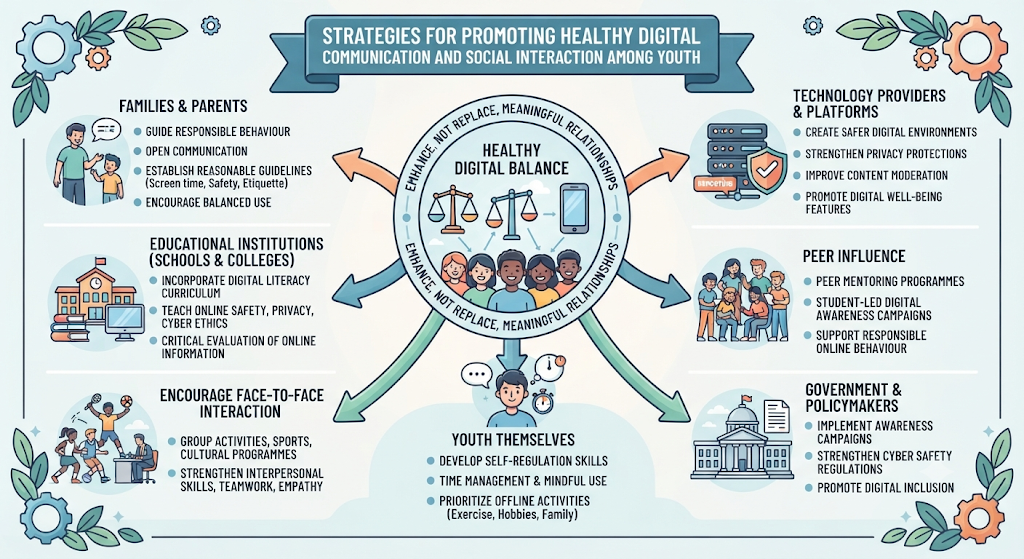
Educational institutions should incorporate digital literacy education into the curriculum. Students should be taught responsible social media use, online safety, privacy protection, cyber ethics, media literacy, and critical evaluation of online information. Awareness programmes can help youth understand both opportunities and risks associated with digital technologies.
Schools and colleges should also encourage face-to-face interaction through group activities, sports, cultural programmes, debates, and collaborative learning experiences. Such activities strengthen interpersonal skills, teamwork, empathy, and social competence.
Counselling services can provide support to students experiencing digital addiction, cyberbullying, social isolation, or emotional difficulties related to technology use. School counsellors should promote healthy coping strategies and emotional well-being.
Technology companies also bear responsibility for creating safer digital environments. Social media platforms should strengthen privacy protections, improve content moderation, provide reporting mechanisms for harmful content, and promote digital well-being features such as screen time monitoring. Youth themselves should develop self-regulation skills. Time management, mindful technology use, regular digital breaks, and prioritization of offline activities can promote balanced lifestyles. Young individuals should be encouraged to engage in physical exercise, hobbies, family interaction, and community participation alongside digital activities. Peer influence can also be utilized positively. Peer mentoring programmes and student-led digital awareness campaigns can encourage responsible online behaviour and support healthy communication practices. Government agencies and policymakers should implement awareness campaigns, strengthen cyber safety regulations, and promote digital inclusion initiatives. Policies supporting online safety, data protection, and responsible technology use are essential. The healthy digital communication requires balance. Mobile technology and social media should enhance rather than replace meaningful human relationships. When used responsibly, digital technologies can contribute significantly to personal development, social participation, and educational advancement among youth.
Conclusion#
The study concludes that mobile technology and social media applications have greatly influenced communication patterns and social interaction among youth. Smartphones, mobile internet, instant messaging, video calls, and social networking platforms have made communication faster, easier, and more frequent. They have also provided youth with new opportunities for self-expression, learning, creativity, social networking, and participation in online communities.
At the same time, excessive use of mobile technology and social media may reduce face-to-face interaction, weaken interpersonal communication skills, increase distraction, disturb studies, and create emotional problems such as anxiety, comparison, loneliness, and fear of missing out. Risks such as cyberbullying, privacy violation, misinformation, and digital addiction are also important concerns.
Therefore, balanced and responsible use of mobile technology is necessary. Parents, teachers, counsellors, policymakers, and youth themselves should promote healthy digital habits, online safety, media literacy, time management, and meaningful offline relationships. Overall, mobile technology and social media can become positive tools for communication and social development when used carefully and responsibly.
Bibliography
Works Cited#
- Boyd, Danah. It’s Complicated: The Social Lives of Networked Teens. Yale University Press, 2014.
- Castells, Manuel. The Rise of the Network Society. 2nd ed., Wiley-Blackwell, 2010.
- Ellison, Nicole B., Charles Steinfield, and Cliff Lampe. “The Benefits of Facebook ‘Friends’: Social Capital and College Students’ Use of Online Social Network Sites.” Journal of Computer-Mediated Communication, vol. 12, no. 4, 2007, pp. 1143–1168.
- Goffman, Erving. The Presentation of Self in Everyday Life. Anchor Books, 1959.
- Jenkins, Henry, et al. Confronting the Challenges of Participatory Culture. MIT Press, 2009.
- Kietzmann, Jan H., et al. “Social Media? Get Serious! Understanding the Functional Building Blocks of Social Media.” Business Horizons, vol. 54, no. 3, 2011, pp. 241–251.
- Lenhart, Amanda. Teens, Social Media & Technology Overview 2015. Pew Research Center, 2015.
- Livingstone, Sonia, and Leslie Haddon, editors. Kids Online: Opportunities and Risks for Children. Policy Press, 2009.
- McLuhan, Marshall. Understanding Media: The Extensions of Man. MIT Press, 1994.
- Papacharissi, Zizi. A Networked Self: Identity, Community, and Culture on Social Network Sites. Routledge, 2011.
- Prensky, Marc. “Digital Natives, Digital Immigrants.” On the Horizon, vol. 9, no. 5, 2001, pp. 1–6.
- Quan-Haase, Anabel. Technology and Society: Social Networks, Power, and Inequality. Oxford University Press, 2020.
- Rainie, Lee, and Barry Wellman. Networked: The New Social Operating System. MIT Press, 2012.
- Rheingold, Howard. The Virtual Community. MIT Press, 2000.
- Turkle, Sherry. Alone Together: Why We Expect More from Technology and Less from Each Other. Basic Books, 2011.
- Valkenburg, Patti M., and Jochen Peter. “Online Communication among Adolescents.” Current Directions in Psychological Science, vol. 18, no. 1, 2009, pp. 1–5.
- Wellman, Barry, and Caroline Haythornthwaite, editors. The Internet in Everyday Life. Blackwell, 2002.
- World Health Organization. Public Health Implications of Excessive Use of the Internet, Computers, Smartphones and Similar Electronic Devices. WHO, 2015.
- boyd, danah m., and Nicole B. Ellison. “Social Network Sites: Definition, History, and Scholarship.” Journal of Computer-Mediated Communication, vol. 13, no. 1, 2007, pp. 210–230.
- Zhao, Shanyang. “Internet and the Transformation of Social Interaction.” Communication Theory, vol. 16, no. 4, 2006, pp. 458–480.