Abstract
Metabolic syndrome — characterized by the clustering of abdominal obesity, insulin resistance, dyslipidemia, and hypertension — represents a growing public-health concern strongly associated with elevated cardiovascular and type-2 diabetes risk. This cross-sectional clinical study assesses the prevalence of metabolic syndrome among adult patients attending primary care clinics, applying standardized diagnostic criteria and examining associated risk factors including dietary patterns, physical activity level, family history, and socioeconomic status. The study further evaluates current screening and early-intervention practices at the primary care level and proposes clinical recommendations for improving metabolic syndrome detection, patient counselling, and multidisciplinary management pathways.
- Metabolic Syndrome
- Primary Care
- Cardiovascular Risk
- Insulin Resistance
- Dyslipidemia
- Clinical Screening
- Preventive Medicine
Introduction#
Cultural diversity is an important feature of modern society. In schools and educational institutions, students come from different cultural, linguistic, religious, regional, caste, ethnic, and socio-economic backgrounds. Each student brings unique traditions, values, beliefs, customs, language, food habits, festivals, and social experiences into the classroom. This diversity makes the school environment rich, dynamic, and meaningful. Multicultural education is an educational approach that recognizes, respects, and includes cultural diversity in the teaching-learning process. It aims to provide equal educational opportunities to all students and develop respect for different cultures. Multicultural education helps students understand that diversity is not a weakness but a strength of society. In culturally diverse classrooms, students learn to interact with classmates who may speak different languages, follow different customs, or belong to different communities. Such interaction develops tolerance, empathy, cooperation, and respect. It also reduces fear, prejudice, and misunderstanding. When students learn together in an inclusive environment, they begin to appreciate similarities and differences among people. Social cohesion refers to unity, trust, cooperation, belongingness, and peaceful relationships among members of a group or society. In schools, social cohesion means that students feel accepted, respected, and connected with one another. Cultural diversity, when supported by inclusive practices, can strengthen social cohesion by encouraging friendship, teamwork, and mutual support among students. Intercultural understanding means the ability to understand, appreciate, and communicate with people from different cultural backgrounds. It includes awareness of different traditions, respect for cultural differences, openness to dialogue, and willingness to learn from others. Multicultural education plays an important role in developing intercultural understanding among students.
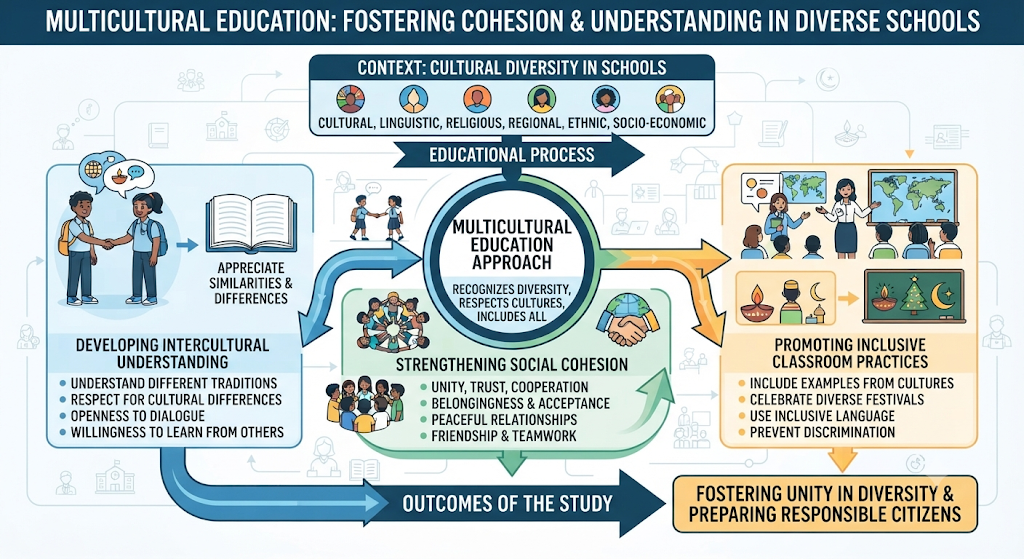
Schools have a major responsibility in promoting multicultural values. Teachers can include examples from different cultures, celebrate diverse festivals, encourage group activities, use inclusive language, and prevent discrimination in the classroom. Curriculum and textbooks should also represent different communities fairly and respectfully. In the present globalized world, students need intercultural skills to live and work in diverse societies. Lack of cultural understanding may lead to stereotypes, discrimination, conflict, bullying, and social division. Therefore, multicultural education is necessary for developing responsible, peaceful, and democratic citizens. The present study is significant because it examines the influence of cultural diversity and multicultural education on social cohesion and intercultural understanding among students. It highlights how schools can promote unity in diversity and prepare students for inclusive social life.
Cultural Diversity in Educational Institutions#
Cultural diversity has become a significant characteristic of contemporary educational institutions across the world. Schools and colleges are increasingly becoming multicultural spaces where students from different cultural, linguistic, religious, ethnic, regional, and socio-economic backgrounds learn together. The presence of diverse cultures within educational settings enriches the learning environment and provides students with opportunities to interact with individuals who possess different beliefs, traditions, customs, languages, and worldviews.
Culture refers to the shared values, beliefs, practices, norms, traditions, language, customs, behaviours, and social experiences that shape the identity of individuals and communities. Every student enters the classroom with a unique cultural background influenced by family, community, religion, language, social class, and regional identity. These cultural experiences influence students' attitudes, learning styles, communication patterns, and social interactions. Therefore, understanding cultural diversity is essential for creating inclusive and effective educational environments.
Educational institutions in many countries, particularly democratic and pluralistic societies, represent diverse populations. Students belonging to different religions, castes, tribes, ethnic groups, linguistic communities, and socio-economic classes often study together within the same institution. Migration, globalization, urbanization, technological advancement, and increasing social mobility have further increased cultural diversity within schools. As societies become more interconnected, educational institutions must respond effectively to the changing cultural composition of student populations.
Cultural diversity in educational institutions offers numerous educational and social benefits. One of the most important advantages is the promotion of broader perspectives. Students who interact with peers from diverse backgrounds gain exposure to different viewpoints, traditions, and experiences. Such exposure encourages critical thinking and helps students understand that social reality can be interpreted in multiple ways. Students become more open-minded and develop the ability to appreciate diversity.
Another important benefit of cultural diversity is the enhancement of social learning. Diverse classrooms provide opportunities for students to interact, communicate, and collaborate with peers from different cultural groups. Through these interactions, students learn essential social skills such as empathy, tolerance, cooperation, respect, and effective communication. These competencies are crucial for functioning successfully in multicultural societies.
Cultural diversity also contributes to personal development. Interaction with diverse peers enables students to reflect upon their own cultural identities while simultaneously appreciating other cultures. Students develop greater self-awareness and cultural sensitivity. They begin to recognize both similarities and differences among people, which promotes mutual respect and reduces ethnocentric attitudes.
Furthermore, culturally diverse educational environments prepare students for global citizenship. In an increasingly globalized world, individuals must possess intercultural competence to work and interact effectively across cultural boundaries. Educational institutions serve as important spaces where students can acquire these competencies. Exposure to cultural diversity helps students develop adaptability, flexibility, and intercultural communication skills necessary for participation in international and multicultural contexts.
Despite its numerous advantages, cultural diversity in educational institutions also presents certain challenges. One major challenge is the existence of stereotypes and prejudices. Students may hold preconceived beliefs or negative attitudes about individuals belonging to different cultural groups. Such stereotypes may lead to discrimination, exclusion, bullying, or social conflict within educational settings. Prejudice can negatively affect students' psychological well-being, academic performance, and sense of belonging.
Language diversity constitutes another challenge in multicultural educational environments. Students from different linguistic backgrounds may experience difficulties in communication and academic participation. Language barriers may hinder effective interaction among students and between students and teachers. Learners who are not proficient in the dominant language of instruction may face academic disadvantages and social isolation.
Socio-economic disparities among culturally diverse students may also influence educational experiences. Students from economically disadvantaged backgrounds may have limited access to educational resources, technology, extracurricular opportunities, and academic support. Such inequalities may affect participation, achievement, and social integration within educational institutions.
Teachers play a crucial role in managing cultural diversity effectively. They must create inclusive classroom environments where all students feel respected, valued, and accepted regardless of their cultural backgrounds. Teachers should recognize and appreciate students' cultural identities rather than expecting uniformity. Inclusive teaching practices help ensure equitable participation and learning opportunities for all students.
Curriculum design is equally important in culturally diverse educational institutions. Curriculum content should reflect the experiences, contributions, histories, and perspectives of different cultural groups. Representation of diverse cultures within textbooks and instructional materials promotes inclusivity and helps students develop respect for cultural pluralism. Biased or exclusionary curriculum content may reinforce stereotypes and marginalization.
Classroom practices should also promote intercultural interaction. Cooperative learning activities, group discussions, cultural exchange programmes, collaborative projects, and celebration of diverse cultural festivals can encourage meaningful interaction among students. Such activities strengthen social relationships and foster positive attitudes toward diversity.
School leadership also influences how cultural diversity is managed within educational institutions. Administrators should establish policies and practices that promote equality, non-discrimination, and inclusion. Schools should provide professional development opportunities that help teachers develop multicultural competencies and culturally responsive teaching skills.
Parental and community involvement further strengthens culturally inclusive educational environments. Collaboration between schools, families, and communities helps educational institutions better understand students' cultural backgrounds and needs. Community participation also promotes mutual trust and shared responsibility for student development.
The concept of culturally responsive education has gained considerable importance in addressing cultural diversity. Culturally responsive education recognizes students' cultural backgrounds as valuable assets in the learning process. Rather than treating diversity as a challenge, this approach views cultural differences as resources that enrich teaching and learning. Teachers adapt instructional strategies to accommodate diverse learning styles, experiences, and cultural perspectives.
Educational institutions must also promote equity alongside diversity. Simply bringing students from different backgrounds together is insufficient. Schools must ensure equal access to quality education, participation opportunities, support services, and academic success for all students. Equity-oriented practices help reduce achievement gaps and promote social justice.
Role of Multicultural Education in Promoting Inclusion#
Multicultural education plays a crucial role in promoting inclusion, equality, and social justice in educational institutions. It is an educational approach that recognizes, respects, and values cultural diversity while ensuring equal learning opportunities for all students regardless of their cultural, linguistic, religious, ethnic, social, or economic backgrounds. In culturally diverse societies, multicultural education serves as an important means of creating inclusive classrooms where every student feels accepted, respected, and valued.
The concept of multicultural education emerged from the need to address inequalities and discrimination in educational systems. Traditional educational practices often reflected the experiences and perspectives of dominant cultural groups while neglecting or marginalizing minority communities. Such practices created educational disparities and limited opportunities for many students. Multicultural education seeks to overcome these limitations by promoting equity, representation, participation, and respect for diversity.
Inclusion in education means ensuring that all students, irrespective of their differences, have equal access to quality education and opportunities for participation. Multicultural education supports inclusive education by acknowledging that students differ in culture, language, religion, social background, abilities, experiences, and learning styles. Rather than expecting students to conform to a single cultural standard, multicultural education encourages educational institutions to adapt teaching practices to meet the diverse needs of learners.
One of the primary roles of multicultural education is promoting respect for cultural diversity. Students often enter schools with preconceived beliefs, stereotypes, and limited understanding of other cultures. Multicultural education provides opportunities for students to learn about different traditions, values, customs, histories, languages, and social practices. Through such learning experiences, students develop appreciation for diversity and recognize that cultural differences enrich society rather than divide it.
Multicultural education also helps reduce prejudice, stereotypes, and discrimination among students. Prejudice and discrimination can create social divisions, exclusion, bullying, and conflict within educational settings. By exposing students to diverse perspectives and encouraging critical examination of biases, multicultural education challenges misconceptions and promotes positive intergroup relations. Students learn to respect differences and reject discriminatory attitudes and behaviours.
Another important role of multicultural education is promoting equality and social justice. Educational inequality often affects students belonging to marginalized or minority groups. Factors such as poverty, language differences, social exclusion, and discrimination may limit educational opportunities for these students. Multicultural education advocates equitable educational practices that ensure all students receive appropriate support, resources, and opportunities for success. It emphasizes fairness rather than uniformity.
Multicultural education contributes significantly to the development of inclusive curriculum. Curriculum plays a vital role in shaping students' understanding of society and culture. Traditional curricula may inadequately represent diverse cultural groups, leading to exclusion and marginalization. Multicultural education encourages the inclusion of multiple cultural perspectives, histories, contributions, and experiences within curriculum content. Such representation validates students' identities and promotes a sense of belonging.
Language inclusion represents another important dimension of multicultural education. Students from different linguistic backgrounds may face challenges in educational settings where the language of instruction differs from their home language. Multicultural education encourages respect for linguistic diversity and promotes strategies that support multilingual learners. Teachers may use bilingual resources, simplified language, visual aids, peer support, and culturally responsive communication to facilitate learning.
Teachers play a central role in implementing multicultural education and promoting inclusion. Effective teachers recognize and value students' cultural backgrounds as important educational resources. They create classroom environments where all students feel respected, safe, and supported. Culturally responsive teachers adapt instructional methods, examples, assessment practices, and classroom interactions to accommodate diverse learners.
Multicultural education also promotes student participation and engagement. Students are more likely to participate actively when they see their cultural identities reflected positively within classroom activities and curriculum. Inclusive educational environments encourage students to share experiences, express opinions, and contribute meaningfully to classroom discussions. Active participation enhances academic achievement and social integration.
Collaborative learning is another strategy promoted through multicultural education. Group activities, cooperative learning, peer tutoring, and collaborative projects provide opportunities for students from different backgrounds to interact and work together. Such interactions strengthen interpersonal relationships, reduce social distance, and foster mutual understanding. Collaborative experiences help students develop teamwork, communication, empathy, and conflict-resolution skills.
Multicultural education further contributes to students' identity development. Students need opportunities to understand and appreciate their own cultural identities while learning about others. Positive affirmation of cultural identity enhances self-esteem, confidence, and academic motivation. Students who feel valued and respected are more likely to engage successfully in learning.
Democratic values constitute another important aspect of multicultural education. Inclusive educational environments promote values such as equality, freedom, respect, tolerance, participation, human rights, and social responsibility. These values are essential for the functioning of democratic societies. Through multicultural education, students learn to participate constructively in diverse communities and contribute positively to society.
The implementation of multicultural education, however, faces several challenges. Teachers may lack adequate training in multicultural pedagogy and culturally responsive teaching. Limited instructional resources, rigid curricula, language barriers, and societal prejudices may also hinder effective implementation. Additionally, resistance to change and insufficient institutional support may limit the success of multicultural initiatives.
To strengthen multicultural education, educational institutions should provide professional development opportunities for teachers, revise curricula to include diverse perspectives, promote inclusive school policies, and encourage community participation. Schools should celebrate cultural diversity through events, exhibitions, intercultural programmes, and collaborative activities. Such initiatives create positive learning environments that support inclusion.
Parental and community involvement is equally important. Families and communities possess valuable cultural knowledge that can enrich educational experiences. Collaboration between schools and communities strengthens cultural understanding and promotes shared responsibility for inclusive education.
Intercultural Understanding and Peaceful Coexistence in Schools#
Intercultural understanding and peaceful coexistence are essential components of contemporary education, particularly in culturally diverse societies. Schools today are increasingly characterized by diversity in terms of language, religion, ethnicity, culture, socio-economic background, and social experiences. In such environments, educational institutions have a significant responsibility to promote mutual understanding, respect, tolerance, and harmonious relationships among students. Intercultural understanding enables students to appreciate cultural differences, while peaceful coexistence ensures that individuals from diverse backgrounds live and learn together in harmony.
Intercultural understanding refers to the ability to recognize, appreciate, respect, and communicate effectively with people belonging to different cultural backgrounds. It involves awareness of one’s own cultural identity as well as sensitivity toward the beliefs, values, traditions, customs, and perspectives of others. Intercultural understanding goes beyond mere knowledge of different cultures; it requires empathy, openness, critical reflection, and willingness to engage in meaningful dialogue with individuals from diverse backgrounds.
Schools are among the most important institutions for promoting intercultural understanding because they bring together students from various social and cultural groups. Daily interaction in classrooms, playgrounds, and extracurricular activities provides students with opportunities to learn from one another and develop positive relationships. Through these interactions, students gain firsthand experiences that help them challenge stereotypes, overcome prejudices, and develop appreciation for diversity.
One of the primary benefits of intercultural understanding is the promotion of mutual respect among students. Respect is a fundamental value necessary for maintaining peaceful relationships in diverse societies. When students understand and appreciate cultural differences, they are less likely to discriminate against or exclude others. Instead, they learn to value diversity as an important social resource. Mutual respect contributes significantly to creating inclusive and supportive school environments.
Intercultural understanding also promotes empathy and compassion. By learning about the experiences, histories, and perspectives of others, students become more sensitive to the feelings and challenges faced by their peers. Empathy enables students to respond positively to differences and support one another during difficult situations. Compassionate behaviour strengthens interpersonal relationships and contributes to social harmony within schools.
Another important contribution of intercultural understanding is the reduction of prejudice, stereotypes, and discrimination. Prejudice often develops due to ignorance, misinformation, or limited interaction with people from different cultural groups. Schools can counter such attitudes by providing opportunities for meaningful intercultural contact and dialogue. Positive interaction helps students recognize common human experiences while appreciating cultural uniqueness. As stereotypes decline, relationships become more inclusive and cooperative.
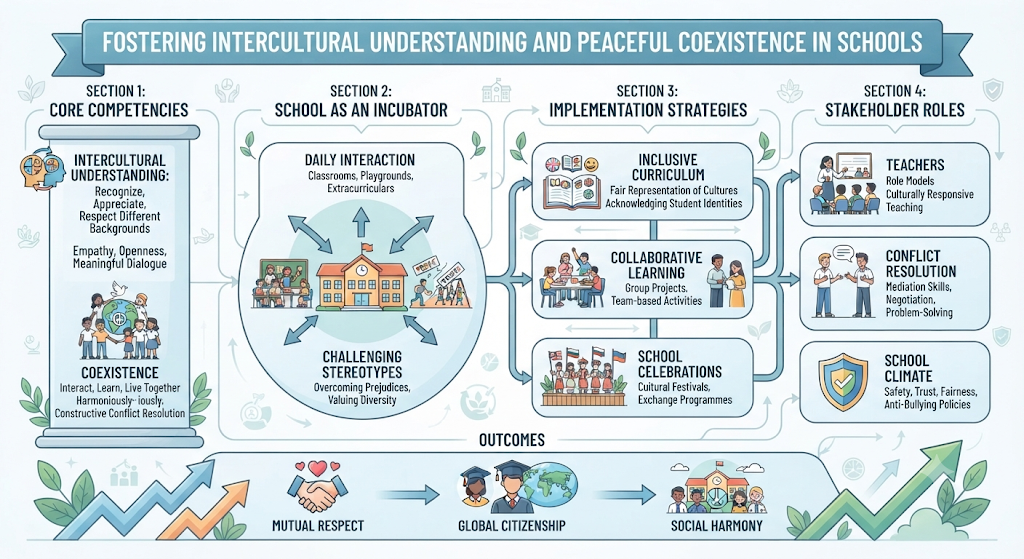
Peaceful coexistence in schools refers to the ability of students from diverse backgrounds to interact, learn, and live together harmoniously despite differences. It involves maintaining positive relationships, resolving conflicts constructively, respecting human dignity, and promoting cooperation rather than confrontation. Peaceful coexistence is particularly important in multicultural educational settings where diversity may sometimes lead to misunderstandings or conflict.
Education for peaceful coexistence emphasizes values such as tolerance, non-violence, equality, justice, cooperation, and respect for human rights. These values help students develop responsible citizenship and contribute positively to society. Schools play an important role in transmitting these values through curriculum, classroom practices, extracurricular activities, and institutional culture.
Multicultural and inclusive educational practices significantly contribute to peaceful coexistence. Curriculum content that represents diverse cultures fairly and respectfully promotes understanding and inclusion. Students who see their identities acknowledged and respected within educational materials develop a stronger sense of belonging. Similarly, exposure to diverse cultural perspectives broadens students' understanding of society and promotes acceptance.
Collaborative learning activities provide valuable opportunities for promoting intercultural understanding and peaceful coexistence. Group projects, cooperative learning tasks, peer tutoring, and team-based activities encourage students from different backgrounds to work together toward common goals. Such experiences strengthen communication skills, cooperation, trust, and social bonds. Collaborative learning also demonstrates that diversity can enhance problem-solving and creativity.
School celebrations and cultural events further promote intercultural understanding. Activities such as cultural festivals, language days, exhibitions, performances, and intercultural exchange programmes allow students to share and celebrate their cultural traditions. Participation in these events fosters pride in one's own heritage while encouraging appreciation of others' cultures. Such experiences contribute to positive intergroup relationships and school unity.
Teachers play a central role in promoting intercultural understanding and peaceful coexistence. Teachers influence students not only through formal instruction but also through their attitudes, behaviours, and interactions. Culturally responsive teachers create inclusive classrooms where all students feel respected and valued. They encourage dialogue, address discriminatory behaviour promptly, and model respect for diversity through their own actions.
Conflict resolution education is another important strategy for promoting peaceful coexistence. Differences among students may occasionally lead to misunderstandings or disagreements. Schools should equip students with skills such as communication, negotiation, mediation, empathy, and problem-solving to address conflicts constructively. Students who possess conflict resolution skills are better able to maintain peaceful relationships and contribute to positive school climates.
School climate significantly affects intercultural relationships. A positive school climate characterized by safety, trust, fairness, and inclusiveness promotes peaceful coexistence among students. School policies should explicitly prohibit discrimination, bullying, harassment, and exclusion. Anti-bullying initiatives, peer support programmes, and student leadership opportunities can strengthen inclusive school environments.
Despite its importance, promoting intercultural understanding faces several challenges. Pre-existing prejudices, societal discrimination, cultural misunderstandings, language barriers, and unequal power relations may hinder positive intercultural interaction. In some cases, students may resist interaction with peers from different backgrounds due to fear or unfamiliarity. Addressing these challenges requires sustained educational efforts and institutional commitment.
Parental and community involvement can strengthen intercultural understanding in schools. Families and communities possess valuable cultural knowledge that can enrich educational experiences. Collaboration between schools and communities promotes mutual understanding and reinforces inclusive values beyond the classroom. Community partnerships also help create supportive environments for culturally diverse students.
Globalization has further increased the importance of intercultural understanding. In an interconnected world, individuals regularly interact with people from diverse cultural backgrounds in educational, professional, and social contexts. Schools must therefore prepare students with intercultural competencies necessary for global citizenship. Such competencies include cultural awareness, empathy, communication skills, adaptability, and respect for diversity.
Conclusion#
The study concludes that cultural diversity and multicultural education play an important role in promoting social cohesion and intercultural understanding among students. Cultural diversity in educational institutions provides students with opportunities to interact with classmates from different religions, languages, regions, communities, and socio-economic backgrounds. Such interaction helps develop respect, empathy, tolerance, cooperation, and acceptance. Multicultural education strengthens inclusion by representing different cultures fairly in curriculum, classroom activities, school celebrations, and teaching practices. It helps reduce stereotypes, prejudice, discrimination, and social distance among students. When students learn about different cultures and work together in inclusive classrooms, they develop a stronger sense of belonging and unity. The study also highlights that social cohesion is strengthened when students feel respected, included, and connected with one another. Intercultural understanding prepares students to communicate peacefully, appreciate diversity, and live harmoniously in a plural society. However, schools must address challenges such as language barriers, cultural bias, bullying, and unequal participation. The multicultural education is essential for building inclusive, democratic, and peaceful school environments. It helps students become socially responsible, culturally sensitive, and respectful citizens.
Works Cited#
- Banks, James A. An Introduction to Multicultural Education. 6th ed., Pearson, 2019.
- Banks, James A., and Cherry A. McGee Banks, editors. Multicultural Education: Issues and Perspectives. 10th ed., Wiley, 2019.
- Bennett, Christine I. Comprehensive Multicultural Education: Theory and Practice. 8th ed., Pearson, 2015.
- Berry, John W. “Acculturation: Living Successfully in Two Cultures.” International Journal of Intercultural Relations, vol. 29, no. 6, 2005, pp. 697–712.
- Brown, Rupert, and Samuel Pehrson. Group Processes: Dynamics within and between Groups. 3rd ed., Wiley-Blackwell, 2019.
- Delors, Jacques, et al. Learning: The Treasure Within. UNESCO, 1996.
- Gay, Geneva. Culturally Responsive Teaching: Theory, Research, and Practice. 3rd ed., Teachers College Press, 2018.
- Gollnick, Donna M., and Philip C. Chinn. Multicultural Education in a Pluralistic Society. 11th ed., Pearson, 2017.
- Grant, Carl A., and Christine E. Sleeter. Doing Multicultural Education for Achievement and Equity. 3rd ed., Routledge, 2020.
- Hall, Edward T. Beyond Culture. Anchor Books, 1976.
- Hollins, Etta R. Culture in School Learning. 3rd ed., Routledge, 2015.
- Kymlicka, Will. Multicultural Citizenship. Oxford University Press, 1995.
- Nieto, Sonia, and Patty Bode. Affirming Diversity: The Sociopolitical Context of Multicultural Education. 7th ed., Pearson, 2018.
- Parekh, Bhikhu. Rethinking Multiculturalism: Cultural Diversity and Political Theory. 2nd ed., Palgrave Macmillan, 2006.
- Sleeter, Christine E. Multicultural Education as Social Activism. SUNY Press, 1996.
- Tatum, Beverly Daniel. Why Are All the Black Kids Sitting Together in the Cafeteria? Basic Books, 2017.
- UNESCO. Guidelines on Intercultural Education. UNESCO, 2006.
- UNESCO. Global Education Monitoring Report 2020: Inclusion and Education. UNESCO, 2020.
- Vygotsky, Lev S. Mind in Society. Harvard University Press, 1978.
- Young, Iris Marion. Justice and the Politics of Difference. Princeton University Press, 1990.
"Examining the Relationship between Lifestyle Practices, Psychological Well-Being, and Quality of Life