Abstract
Minimally invasive surgical techniques, including laparoscopic and robot-assisted approaches, have increasingly replaced traditional open surgery for a range of elective abdominal procedures, driven by reported advantages in postoperative pain, hospital stay, and recovery time. This study conducts a comparative clinical evaluation of postoperative outcomes — including surgical site infection rates, length of hospital stay, analgesic requirement, and time to return to normal activity — between minimally invasive and open surgical cohorts undergoing comparable elective abdominal procedures. Secondary analysis examines cost-effectiveness and surgeon learning-curve considerations associated with minimally invasive adoption in resource-variable clinical settings. Findings are intended to inform evidence-based surgical decision-making and perioperative care protocol development.
- Minimally Invasive Surgery
- Laparoscopic Surgery
- Postoperative Outcomes
- Surgical Site Infection
- Perioperative Care
- Elective Surgery
- Clinical Outcomes
Introduction#
Financial literacy, digital banking adoption and investment behaviour have become important areas of study in the present economic and technological environment. Young adults are entering financial life at a time when banking services, saving methods, payment systems and investment options are rapidly changing. Earlier, financial activities were mainly limited to physical banks, cash transactions and traditional saving practices. Today, mobile banking, internet banking, UPI, digital wallets, online trading applications, mutual fund platforms and digital payment systems have changed the way individuals manage money. Therefore, understanding the financial knowledge, digital banking habits and investment behaviour of young adults has become highly significant.
Financial literacy refers to the knowledge, awareness and ability to understand and use financial concepts effectively. It includes understanding income, saving, budgeting, banking, credit, insurance, interest rates, risk, return and investment planning. A financially literate individual is better able to make informed financial decisions and avoid unnecessary debt, fraud and poor investment choices. Among young adults, financial literacy is especially important because this stage involves the beginning of independent financial decision-making, career planning, income generation, saving habits and long-term investment planning.
Digital banking adoption refers to the acceptance and use of digital financial services such as mobile banking, internet banking, UPI payments, debit and credit cards, digital wallets and online financial applications. Digital banking provides convenience, speed, transparency and wider access to banking services. It reduces the need to visit bank branches and allows users to transfer money, pay bills, check balances, apply for services and invest online. However, adoption of digital banking depends on factors such as digital literacy, internet access, trust, security awareness, ease of use and financial confidence.
Investment behaviour is closely related to financial literacy and digital banking adoption. It refers to the way individuals save, invest, take risk, select investment instruments and plan for future financial goals. Young adults may invest in fixed deposits, recurring deposits, mutual funds, shares, insurance products, gold, government schemes and digital investment platforms. Their investment behaviour is influenced by income level, education, family background, financial awareness, peer influence, risk tolerance and access to financial services. Proper financial literacy can help young adults understand risk and return, diversify investments and make disciplined financial decisions.
The comparison between urban and rural communities is important in this study because financial access and digital adoption may differ significantly between these two groups. Urban young adults generally have better access to banks, internet connectivity, smartphones, financial institutions and investment platforms. They may also receive more exposure to financial information through education, employment and media. Rural young adults, on the other hand, may face challenges such as limited banking facilities, poor internet connectivity, lower digital literacy, dependence on traditional saving methods and lack of awareness regarding investment options. However, the expansion of digital India initiatives, Jan Dhan accounts, UPI services and mobile connectivity has increased financial inclusion in rural areas also.
The relationship among financial literacy, digital banking adoption and investment behaviour is highly meaningful. Financially literate young adults are more likely to understand digital banking services and use them confidently. Digital banking adoption can further improve investment behaviour by providing easy access to savings accounts, online deposits, mutual funds, stock market platforms and insurance services. When young adults possess both financial knowledge and digital access, they can make better financial decisions and participate more actively in formal financial systems.
The present study titled “Assessment of Financial Literacy, Digital Banking Adoption, and Investment Behaviour among Young Adults in Urban and Rural Communities” is significant because it focuses on the financial preparedness of youth in a changing economic environment. Young adults form an important segment of the population and their financial decisions affect household welfare, economic stability and national financial inclusion. The study attempts to assess their level of financial literacy, extent of digital banking adoption and pattern of investment behaviour. It also seeks to understand differences between urban and rural communities.
This study is useful for policymakers, banks, educational institutions, financial service providers and community organizations. Findings may help in designing financial education programmes, digital banking awareness campaigns, investor education initiatives and rural financial inclusion strategies. In the present age, financial empowerment is not possible only through access to banking services; it also requires knowledge, confidence and responsible financial behaviour.
Thus, financial literacy, digital banking adoption and investment behaviour are interconnected dimensions of financial development among young adults. Higher financial literacy promotes better understanding of digital banking and investment opportunities, while digital banking provides practical access to financial services. Balanced financial knowledge and responsible digital use can help young adults become financially independent, secure and future-oriented. Therefore, the study of these variables in urban and rural communities is highly relevant in the context of inclusive economic growth and digital financial transformation.
Concept and Importance of Financial Literacy among Young Adults#
Financial literacy has emerged as an essential life skill in the contemporary economic environment. Rapid changes in financial markets, technological innovations, digital financial services, and increasing availability of diverse investment options have made financial knowledge indispensable for individuals. Young adults, in particular, face numerous financial decisions related to education, employment, savings, borrowing, investments, insurance, and retirement planning. Consequently, understanding the concept and importance of financial literacy among young adults has become increasingly significant for promoting financial well-being and economic security.
Financial literacy refers to the knowledge, skills, awareness, and confidence required to make informed and effective financial decisions. It involves understanding basic financial concepts such as budgeting, saving, interest rates, inflation, credit management, risk diversification, investment planning, and financial products. According to the Organization for Economic Co-operation and Development (OECD, 2018), financial literacy is a combination of awareness, knowledge, skills, attitudes, and behaviours necessary to make sound financial decisions and achieve individual financial well-being. Thus, financial literacy extends beyond mere knowledge of financial concepts and includes the ability to apply such knowledge in practical financial situations.
The concept of financial literacy encompasses several dimensions. One important dimension is financial knowledge, which refers to understanding fundamental financial principles and concepts. Financially knowledgeable individuals are familiar with concepts such as simple and compound interest, inflation, risk and return, diversification, taxation, and various saving and investment instruments. Such knowledge enables individuals to evaluate financial alternatives and make rational economic decisions.
Another important dimension is financial behaviour, which refers to the actual financial practices adopted by individuals in their daily lives. Financial behaviour includes budgeting, saving regularly, maintaining financial records, timely repayment of debts, prudent use of credit, and long-term financial planning. Positive financial behaviours contribute significantly to financial stability and wealth accumulation. Conversely, poor financial behaviour may result in excessive debt, inadequate savings, and financial insecurity.
Financial attitude constitutes another important component of financial literacy. Financial attitude reflects individuals' values, beliefs, and preferences regarding money management, savings, expenditure, and investment. Individuals with positive financial attitudes are generally future-oriented, financially disciplined, and willing to engage in long-term financial planning. Such attitudes encourage responsible financial behaviour and contribute to improved financial outcomes.
In the present digital era, financial literacy has acquired greater importance due to the increasing complexity of financial systems. Young adults are exposed to numerous financial products and services, including savings accounts, credit cards, insurance policies, mutual funds, stock market investments, digital payment systems, and online banking platforms. Without adequate financial knowledge, young individuals may face difficulties in evaluating these products and may become vulnerable to financial mistakes, fraud, excessive borrowing, or inappropriate investment decisions.
Young adulthood represents a critical stage in the financial life cycle. During this period, individuals often begin earning income, pursuing higher education, managing personal expenses, opening bank accounts, taking educational loans, and making independent financial decisions for the first time. Decisions made during this stage have long-term implications for future financial security and well-being. Lusardi and Mitchell (2014) argued that financial literacy is essential for enabling individuals to make informed decisions regarding savings, investments, retirement planning, and debt management throughout their lives.
One of the major reasons for emphasizing financial literacy among young adults is its role in promoting effective money management. Financially literate individuals are better able to prepare budgets, monitor expenditures, distinguish between needs and wants, and allocate resources efficiently. Budgeting enables individuals to control unnecessary spending, increase savings, and avoid financial difficulties. Sound money management practices contribute to financial discipline and long-term economic stability.
Financial literacy also plays a crucial role in encouraging saving behaviour. Savings provide financial security during emergencies, support future goals, and facilitate wealth creation. Young adults who understand the importance of regular savings are more likely to develop healthy financial habits and achieve financial independence. Financial literacy encourages individuals to adopt systematic saving practices and utilize formal financial institutions effectively.
Another significant importance of financial literacy lies in facilitating informed investment decisions. Contemporary financial markets offer a wide range of investment opportunities, including fixed deposits, mutual funds, stocks, bonds, insurance products, pension schemes, gold, and digital investment platforms. Each investment alternative differs in terms of risk, return, liquidity, and suitability. Financial literacy enables young adults to assess investment options critically, diversify investments, and align investment decisions with their financial goals and risk tolerance. Without adequate financial literacy, individuals may either avoid investments altogether or engage in inappropriate and risky financial activities.
Financial literacy is equally important for effective debt and credit management. The increasing availability of credit cards, educational loans, personal loans, and digital lending platforms has expanded access to credit among young adults. However, excessive borrowing and poor debt management can lead to financial distress and long-term indebtedness. Financial literacy helps individuals understand interest rates, repayment obligations, credit scores, and responsible borrowing practices, thereby reducing the risk of financial problems.
In recent years, the rapid expansion of digital financial services has further increased the importance of financial literacy. Digital banking, mobile payments, internet banking, Unified Payments Interface (UPI), digital wallets, and online investment platforms have transformed financial transactions and service delivery. Although these innovations offer convenience and accessibility, they also require individuals to possess adequate digital and financial competencies. Financial literacy enables young adults to utilize digital financial services safely, efficiently, and confidently while protecting themselves against cyber fraud and financial scams.
Digital Banking Adoption in Urban and Rural Communities#
Digital banking adoption refers to the acceptance and use of electronic banking services by individuals for financial transactions and money management. It includes mobile banking, internet banking, UPI payments, debit and credit cards, digital wallets, online fund transfer, bill payment, balance enquiry, account statements, and online investment services. In the present digital economy, banking is no longer limited to physical branches. Young adults increasingly use smartphones and internet-based applications to perform financial activities quickly and conveniently.
Digital banking has become an important tool for financial inclusion because it reduces the need for physical visits to banks and makes financial services available at any time and place. It provides speed, convenience, transparency, lower transaction cost, and easy access to banking facilities. For young adults, digital banking is especially useful because they are more familiar with mobile technology and online platforms. They use digital banking for daily payments, shopping, education fees, money transfers, savings, and investment-related activities.
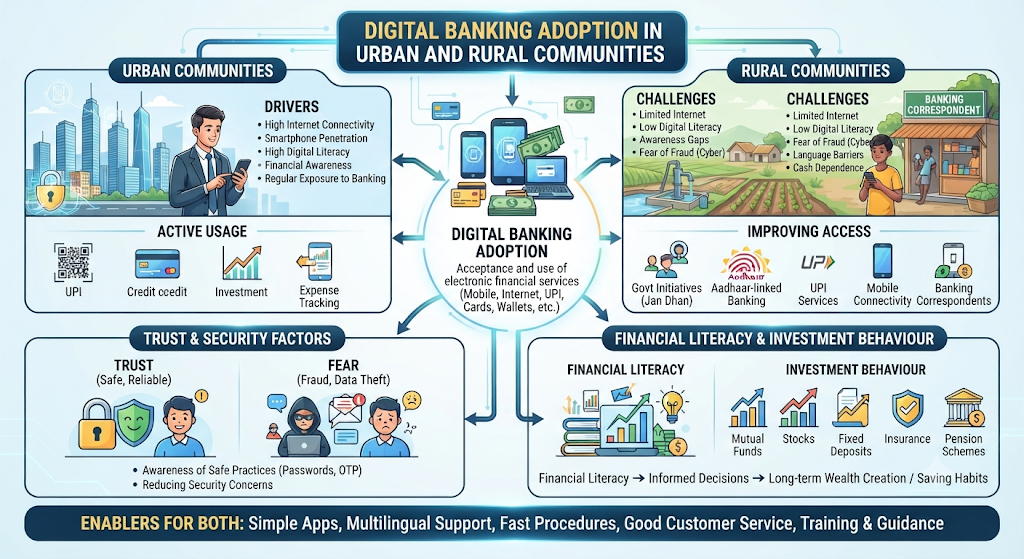
Figure: Digital Banking Adoption in Urban and Rural Communities
In urban communities, digital banking adoption is generally higher due to better internet connectivity, smartphone availability, higher literacy levels, regular exposure to banking services, and greater awareness of digital financial tools. Urban youth often use UPI applications, mobile banking, credit cards, online wallets, and investment platforms with greater confidence. They are also more likely to compare financial products, track expenses, and use online services for loans, insurance, and mutual funds.
In rural communities, digital banking adoption is increasing, but it still faces several challenges. Limited internet connectivity, low digital literacy, lack of awareness, fear of fraud, language barriers, and dependence on cash transactions may reduce the use of digital banking services. Many rural young adults may have bank accounts but may not use digital services regularly due to lack of confidence or technical knowledge. However, government initiatives, Jan Dhan accounts, UPI services, Aadhaar-linked banking, mobile connectivity, and banking correspondents have improved access to digital financial services in rural areas.
Trust and security are important factors influencing digital banking adoption in both urban and rural communities. Users are more likely to adopt digital banking when they believe that transactions are safe, easy, and reliable. Fear of cyber fraud, wrong transactions, password misuse, phishing, and data theft may discourage users from adopting digital banking. Therefore, awareness about safe digital practices, strong passwords, OTP protection, and fraud prevention is necessary for increasing digital banking confidence.
Ease of use also plays a major role in digital banking adoption. If banking applications are simple, user-friendly, multilingual, and fast, young adults are more likely to use them. Complicated procedures, technical errors, poor customer support, and failed transactions may reduce user satisfaction. Urban youth may overcome these problems more easily due to better digital exposure, while rural youth may need more training and guidance.
Digital banking adoption is closely related to financial literacy. A financially literate young adult can better understand digital banking services, transaction charges, interest rates, online savings, credit facilities, and investment options. Without financial literacy, digital banking may be used only for basic payments rather than for broader financial planning. Thus, financial knowledge and digital skills together determine the effective use of digital banking.
The adoption of digital banking also influences investment behaviour. Digital platforms provide easy access to mutual funds, stocks, fixed deposits, insurance, pension schemes, and other investment products. Young adults who use digital banking confidently are more likely to explore online investment opportunities. This can promote saving habits, financial planning, and long-term wealth creation. However, lack of knowledge may also lead to risky investment decisions through unverified apps or misleading online advice.
Investment Behaviour and Financial Decision-Making among Young Adults#
Investment behaviour refers to the pattern, attitude and decision-making process through which individuals select different financial instruments for saving and wealth creation. Among young adults, investment behaviour is an important indicator of financial maturity because this stage marks the beginning of independent earning, saving, spending and future planning. Young adults may invest in fixed deposits, recurring deposits, mutual funds, shares, insurance policies, gold, government schemes, pension plans and digital investment platforms.
Financial decision-making among young adults is influenced by several factors such as income level, education, family background, financial literacy, peer influence, risk-taking ability, awareness of investment options and access to digital banking services. Young adults with higher financial literacy are more likely to understand risk and return, compare investment alternatives and make informed financial choices. On the other hand, low financial knowledge may lead to poor saving habits, dependence on informal advice, impulsive spending and risky investment decisions.
Risk preference plays a major role in investment behaviour. Some young adults prefer safe investment options such as fixed deposits, savings accounts and government schemes, while others may choose higher-risk options such as shares, mutual funds and online trading platforms. The selection of investment instruments depends on financial goals, expected return, liquidity needs and confidence in financial markets. Proper financial awareness helps young investors balance risk and return in a responsible manner.
Digital banking and financial technology have also changed investment behaviour among young adults. Mobile applications, UPI-linked platforms, online mutual fund portals and stock trading apps have made investment easier and faster. Young adults can now invest small amounts, track returns, compare schemes and manage portfolios through smartphones. However, easy access to digital platforms may also encourage impulsive investment if users lack proper knowledge.
Urban and rural differences are also visible in investment behaviour. Urban young adults generally have greater exposure to formal financial products, online investment platforms and professional financial advice. Rural young adults may depend more on traditional saving methods such as gold, cash savings, land, livestock, post office schemes and bank deposits. However, increasing digital banking access is gradually encouraging rural youth to participate in formal investment channels.
Thus, investment behaviour and financial decision-making among young adults are shaped by financial literacy, digital access, risk attitude, income and social environment. Responsible investment behaviour can promote financial security, wealth creation and economic independence. Therefore, financial education and digital awareness are essential for helping young adults make informed, safe and future-oriented investment decisions.
Relationship among Financial Literacy, Digital Banking Adoption and Investment Behaviour#
Financial literacy, digital banking adoption and investment behaviour are closely interconnected aspects of financial development among young adults. Financial literacy provides the basic knowledge and confidence required to understand banking services, digital payment systems, saving methods and investment options. When young adults have better financial literacy, they are more likely to use digital banking services effectively and make informed investment decisions.
Financial literacy acts as the foundation of responsible financial behaviour. A young adult who understands budgeting, saving, interest rates, risk, return and financial planning can use digital banking services more confidently. Such individuals are better able to compare financial products, understand transaction charges, avoid fraud and select suitable investment options. On the other hand, low financial literacy may result in poor money management, unsafe digital practices and uninformed investment decisions.
Digital banking adoption works as a bridge between financial knowledge and practical financial action. Mobile banking, internet banking, UPI, digital wallets and online investment platforms provide easy access to financial services. When young adults adopt digital banking, they can save money, transfer funds, pay bills, monitor expenses and invest through online platforms. Thus, digital banking converts financial awareness into actual financial participation.
Investment behaviour is influenced by both financial literacy and digital banking adoption. Financially literate young adults are more likely to understand the importance of saving and investing for future goals. Digital banking platforms make investment easier by providing access to mutual funds, fixed deposits, insurance products, stock market apps and government schemes. Therefore, higher financial literacy combined with digital banking adoption can lead to better investment behaviour.
In urban communities, this relationship is often stronger because young adults generally have better access to internet facilities, smartphones, financial institutions and investment platforms. Urban youth may use digital banking not only for payments but also for online savings, mutual funds and stock market investment. In rural communities, financial literacy and digital adoption may be comparatively lower due to limited awareness, digital barriers and dependence on traditional financial practices. However, increasing mobile connectivity and financial inclusion programmes are gradually improving rural participation in digital banking and investment activities.
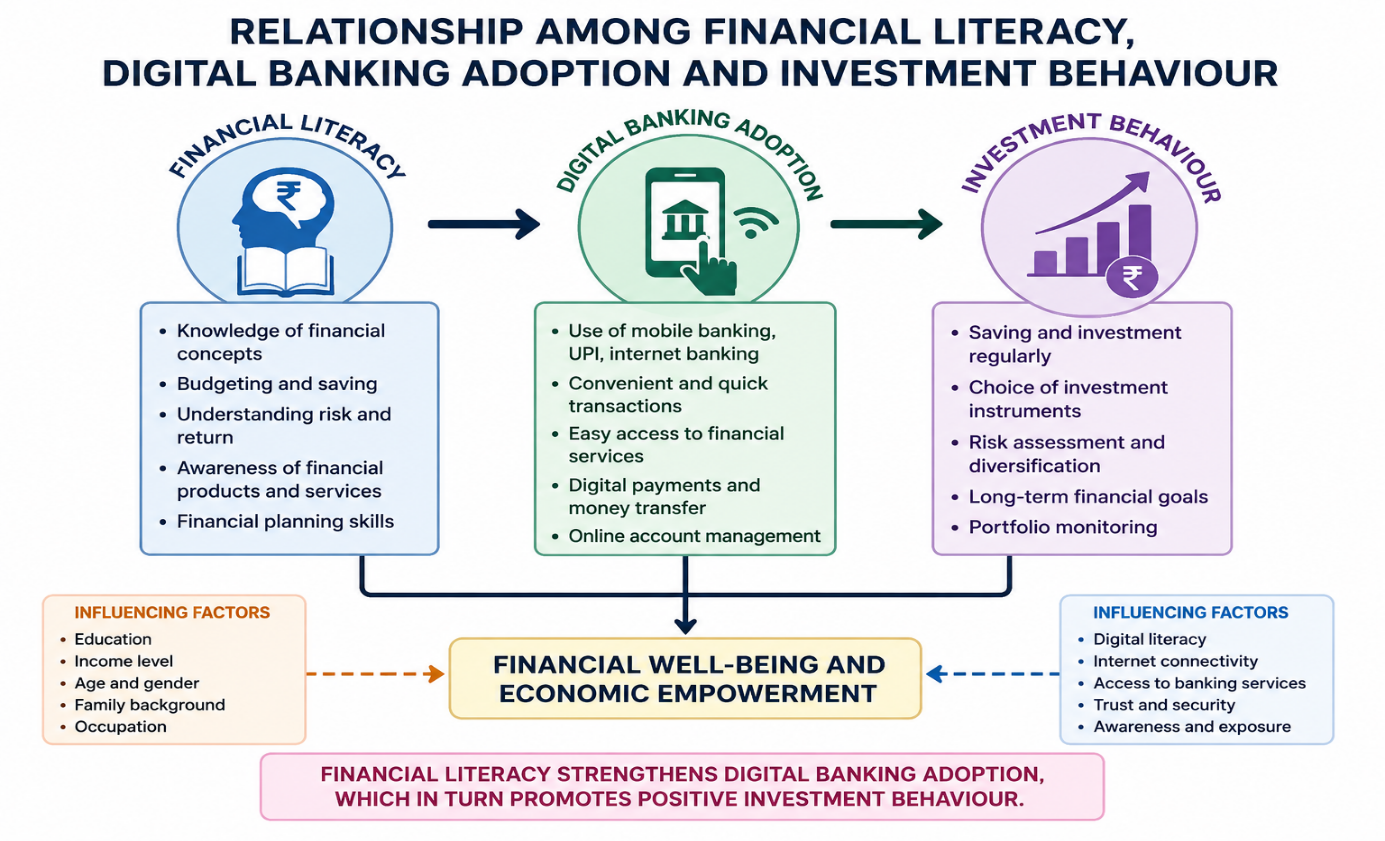
The relationship can be understood in a sequential manner: financial literacy improves awareness and confidence; digital banking adoption provides access and convenience; and investment behaviour reflects the practical outcome of financial knowledge and digital usage. A young adult with good financial literacy and digital banking access is more likely to make safe, planned and goal-oriented investment decisions.
Thus, financial literacy, digital banking adoption and investment behaviour support one another. Financial literacy strengthens understanding, digital banking enables financial action, and investment behaviour promotes long-term financial security. Therefore, improving financial education and digital banking awareness among young adults is essential for promoting financial inclusion, responsible investment and economic empowerment in both urban and rural communities.
Conclusion#
Financial literacy, digital banking adoption, and investment behaviour are fundamental components of financial well-being in the contemporary digital economy. The present study highlights that young adults require adequate financial knowledge and digital competencies to make informed financial decisions and effectively participate in formal financial systems. Financial literacy equips individuals with the knowledge and skills necessary for budgeting, saving, borrowing, and investment planning, while digital banking provides convenient and accessible financial services that facilitate day-to-day financial transactions.
The study also emphasizes that digital banking adoption has transformed the financial behaviour of young adults by enhancing access to banking and investment services. However, differences between urban and rural communities continue to exist due to variations in financial awareness, digital infrastructure, internet accessibility, and technological skills. Urban young adults generally demonstrate higher levels of digital banking usage and investment participation, whereas rural youth may face challenges related to awareness, connectivity, and confidence in using digital financial services.
Furthermore, the findings suggest that financial literacy positively influences digital banking adoption and investment behaviour. Young adults possessing higher financial knowledge are more likely to adopt digital banking services and make rational, goal-oriented investment decisions. Therefore, promoting financial education, strengthening digital literacy, expanding financial inclusion initiatives, and improving access to secure digital banking platforms are essential for enhancing responsible financial behaviour among young adults.
Works Cited#
- Agarwal, R., and Prasad, J. “The Role of Innovation Characteristics and Perceived Voluntariness in the Acceptance of Information Technologies.” Decision Sciences, vol. 28, no. 3, 1997, pp. 557–582.
- Ajzen, Icek. “The Theory of Planned Behavior.” Organizational Behavior and Human Decision Processes, vol. 50, no. 2, 1991, pp. 179–211.
- Atkinson, Adele, and Flore-Anne Messy. “Measuring Financial Literacy: Results of the OECD/International Network on Financial Education Pilot Study.” OECD Working Papers on Finance, Insurance and Private Pensions, no. 15, 2012.
- Davis, Fred D. “Perceived Usefulness, Perceived Ease of Use, and User Acceptance of Information Technology.” MIS Quarterly, vol. 13, no. 3, 1989, pp. 319–340.
- Hilgert, Marianne A., Jeanne M. Hogarth, and Sondra G. Beverly. “Household Financial Management: The Connection between Knowledge and Behavior.” Federal Reserve Bulletin, vol. 89, 2003, pp. 309–322.
- Lusardi, Annamaria, and Olivia S. Mitchell. “The Economic Importance of Financial Literacy: Theory and Evidence.” Journal of Economic Literature, vol. 52, no. 1, 2014, pp. 5–44.
- Lusardi, Annamaria, Olivia S. Mitchell, and Vilsa Curto. “Financial Literacy among the Young.” Journal of Consumer Affairs, vol. 44, no. 2, 2010, pp. 358–380.
- OECD. OECD/INFE Toolkit for Measuring Financial Literacy and Financial Inclusion. OECD, 2018.
- Prasad, H. N., and Megha. “Financial Literacy and Financial Inclusion in India.” International Journal of Business and Management Invention, vol. 6, no. 3, 2017, pp. 41–48.
- Remund, David L. “Financial Literacy Explicated: The Case for a Clearer Definition in an Increasingly Complex Economy.” Journal of Consumer Affairs, vol. 44, no. 2, 2010, pp. 276–295.
- Reserve Bank of India. National Strategy for Financial Education 2020–2025. RBI, 2020.
- Rogers, Everett M. Diffusion of Innovations. 5th ed., Free Press, 2003.
- Sahi, Shalini K. “Financial Literacy Education for the Indian Consumer: The Road to Economic Development.” International Journal of Indian Culture and Business Management, vol. 6, no. 2, 2013, pp. 247–260.
- Venkatesh, Viswanath, et al. “User Acceptance of Information Technology: Toward a Unified View.” MIS Quarterly, vol. 27, no. 3, 2003, pp. 425–478.
- Yoong, Joanne. “Financial Illiteracy and Stock Market Participation: Evidence from the RAND American Life Panel.” Pension Research Council Working Paper, 2011.